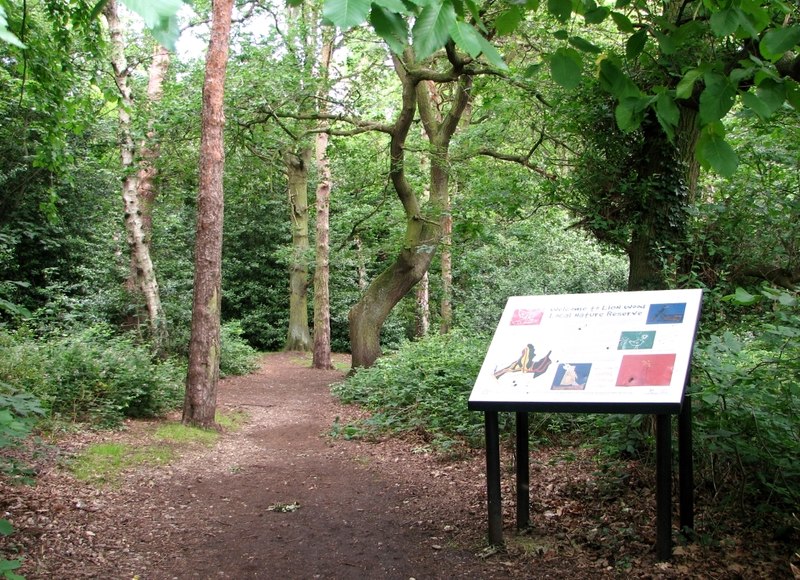
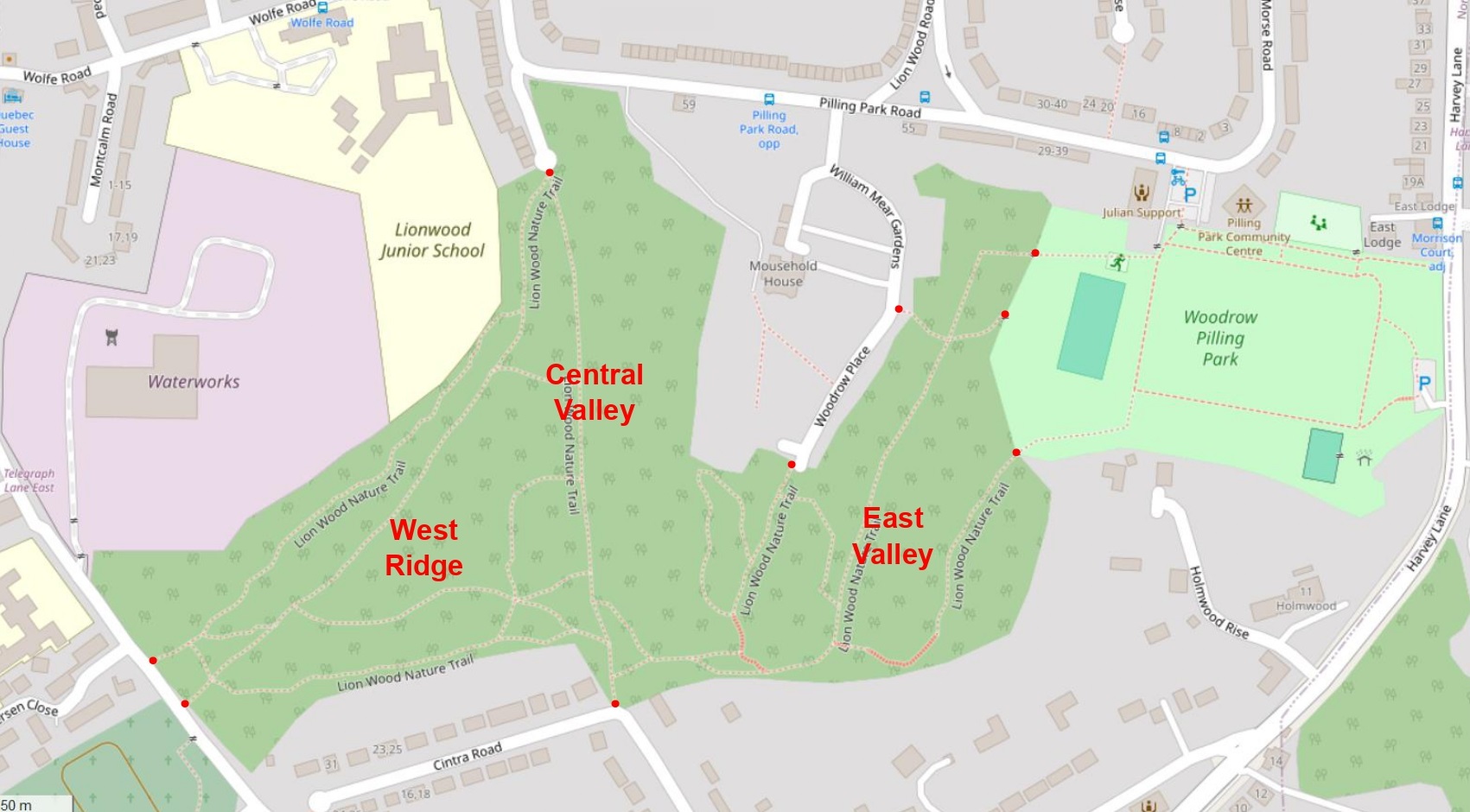
Lion Wood is a beautiful woodland nestled in the heart of Norwich covering around 9 hectares (22 acres). It is one of the few remaining ancient woods in the city and loved by local residents, dog walkers, runners, fort-builders and wildlife alike. Part of Thorpe Hamlet, it borders several residential areas, stretching from Telegraph Lane (adjoining the Telegraph Plantation) on its west side, to Pilling Park on its east and running between Wellesley Avenue South and North.
English Bluebells, Wood Sorrel, Dog’s Mercury, Spurge Laurel and the rare Great Wood-rush are all found in the wood, along with some large Pedunculate Oaks, Hornbeam and Beech. These plants do not spread easily and the oaks will have taken hundreds of years to reach their current size. Their presence in the wood indicates that it was established a very long time ago.
Thorpe Woods are mentioned in the Domesday Book of 1086. What we now know as Lion Wood would have formed part of Thorpe Woods, so the wood was already well established more than a thousand years ago. The land profile (the slope of the ground, hills and valleys) was probably created during the period of Woolstonian Glaciation.
There is some debate about the origin of the name “Lion Wood”. The Thorpe Hamlet History Group speculated that it may have come from Ralph De Lène who had leased the wood when it formed part of the larger Thorpe Woods. There is also an idea that it comes from a corruption of an old English word which was used to denote common grazing ground. The old woods would have been an ideal place to graze pigs.
A more recent theory comes from ancient maps of the area. Apparently the path linking the Wellesley Avenues was marked as “Layne” which may have meant this part of the larger wood came to be known as “Layne Wood”.
A Short History of Woodland in Thorpe
Lion Wood Public Facebook Page
Copyright © 2026 Lion Wood Conservation Group